Are you still thinking about varieties for the upcoming season? Purdue has been keeping a record of vegetable variety trials in the Midwest since 1999. The Midwest Vegetable Trial Report series includes reports of applied research relevant to vegetable and melon production in the Midwest. Here are some abstracts of the most recent reports. Visit…Read more about Selecting Vegetable Varieties for your Farm[Read More]
Solanaceous Crops
Vegetable growers may be wondering when to apply the final fungicide application. It is important to leave the crop protected until the last harvest. Yet, it is important not to waste fungicides. In most cases, the last fungicide application should occur 10 to 14 days from the final harvest. Most fungicides that are designed to…Read more about The Final Fungicide Application[Read More]
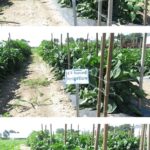
At Pinney Purdue (PPAC) bell peppers were harvested for the first time on August 15. Plants appear a little larger in the irrigated plots than in the unirrigated plots, but it is not obvious in photographs (Figure 1). Similar to what was observed at SWPAC, blossom end rot (BER) was much more common in the…Read more about Irrigation Demonstration Update July Aug. 24, 2022, Pinney Purdue Ag Center.[Read More]
This is the fourth article in a series that describes the three primary bacterial diseases of tomato: bacterial canker, bacterial speck and bacterial spot. This article is a general summary of management options for these diseases. All three of these diseases may be seed borne and brought into to field situation on transplants. It is…Read more about General Management Options for Bacterial Diseases of Tomato[Read More]
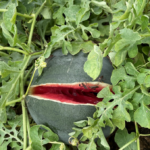
We received more than 8 inches of rain since the evening of July 24 at Southwest Purdue Ag Center. This article discusses a few plant physiological disorders we observed after the heavy rains. We noticed a large percentage of cracked fruit on tomatoes at the stem end (Figure 1). Fruit cracking is a physiological disorder…Read more about Physiological Disorders after Heavy Rains[Read More]
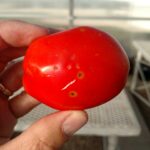
The following is an article in one of a series about bacterial diseases of tomato. Previously, articles about bacterial canker and bacterial spot have been featured here. The next article will be about general management methods for bacterial diseases of tomato. Bacterial speck causes lesions on all above ground portions of the tomato, in a…Read more about Bacterial Speck of Tomato[Read More]

We observed a large amount of unmarketable pepper fruit hanging on the plants during on-farm visits and at the research farms recently. Damage appears on the sides or at the bottom of the fruit (Figure 1). The symptoms that occur at the fruit bottom are similar to tomato blossom end rot (BER), a plant physiological…Read more about Unmarketable Bell Peppers[Read More]
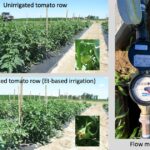
At Pinney Purdue (PPAC) 1.66 inches of rain fell June 25 through July 11. The potential evapotranspiration (PET) over the period was 2.79 inches. Estimates for water use by the crops are lower than potential evapotranspiration because it is only 5 weeks after transplanting. For tomatoes, estimated water use was 2.01 inches, and for watermelons,…Read more about Irrigation Demonstration Update — PPAC July 11[Read More]
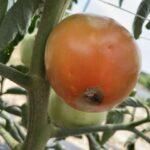
After planting on May 16, we only received 1.4 inches of rain in June. The early-setting tomatoes on plants grown on the unirrigated bed had more than 40% fruit blossom end rot (BER) (recorded on June 23). It was 3% on plants grown in a bed that received 17 irrigation events in June and 10%…Read more about Irrigation Demonstration Update — SWPAC July 13[Read More]
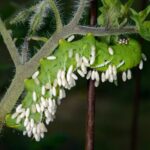
The tobacco hornworm is one of the most devastating tomato pests in Indiana, if left unchecked. There are several natural enemies that help suppress this pest, such as stilt bugs (Figure 1), spined soldier bugs (Figure 2) and the parasitoid Cotesia congregata (Figure 3). Often, these natural enemies are not abundant until later in the…Read more about The Hornworms are Here![Read More]