The 2019 production season started with above-normal rains. The wet conditions affected agriculture production, including watermelon and cantaloupe. In this article, we will review some of the watermelon and cantaloupe problems that are often associated with wet conditions. Manganese toxicity– This nutrient disorder occurs more often on cantaloupe that is grown in soils with pH…Read more about Results of Wet Condition on Watermelon and Cantaloupe[Read More]
Cucurbits

The wet spring has likely delayed some planting of pumpkins. What does delayed planting mean for yield? Data and observations from Purdue Ag Centers offer some perspective to supplement other experience. Figure 1 shows how pumpkin yield was affected by planting date for 6 trials. Each line represents a different trial. The Y-axis shows relative…Read more about Considerations with Delayed Pumpkin Planting[Read More]
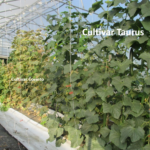
Supported by NC SARE (LNC17-390), we are continuing research for improving high tunnel cucumber production. One of the biggest challenges for growing cucumbers in high tunnels in the summer is two-spotted spider mites. Dry and hot environments featured in high tunnels allow two-spotted spider mite populations to increase rapidly. The mites cause leaf yellowing, necrosis,…Read more about Watch for Two-spotted Spider Mites on High Tunnel Cucumbers[Read More]
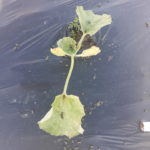
I know this may not come as a surprise to most of you, but it is rare that we get to observe the effectiveness of insecticides in such a dramatic way as we encountered when visiting a melon grower in southern IN recently. And in this case, the decision to apply an insecticide at transplant…Read more about Insecticides Kill Insects[Read More]

Finally the time has come to plant warm season crops. Zucchini is a popular summer squash grown throughout Indiana and the United States. It always delivers a bounty of fruit. Yes, technically zucchini is a fruit (botanically classified as a modified berry) but as per the USDA it is listed under the ‘Vegetables and Vegetable…Read more about Growing a Bountiful Zucchini Crop[Read More]
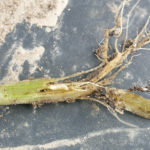
In addition to delaying much of our fieldwork, the cool set spring has wreaked havoc on some of the plants we have been able to squeeze in during brief dry periods. We have received reports of damage caused by seedcorn maggots (Figure 1) and wireworms (Figure 2). In preparation of this article I browsed the…Read more about Seedcorn Maggots and Wireworms in Cucurbits[Read More]
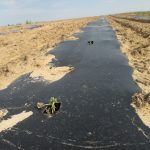
In the past week, we have observed a few cases where newly planted watermelon seedlings were severely damaged or dead (Figure 1). In some fields, we observed rotted roots and lower stems caused by fungal pathogens. However, such diseases were in response to the cold soils and would not normally cause problems in warm soils….Read more about Low Temperature Caused Watermelon Establishment Failure[Read More]
In response to the many questions about this disease on cucurbits, a new extension bulletin has been produced. The bulletin may be accessed at the link below. Or contact me to get your copy. https://www.extension.purdue.edu/extmedia/bp/bp-204-w.pdf
Ever year, I put together fungicide schedules for cucurbits. These may be found at purdue.ag/pumpkinfs and purdue.ag/melonfs. They may be downloaded as PDFs on legal sized pages. Please use these tables along with the MW Vegetable Production Guide and the fungicide label. If you have trouble with accessing the tables or have other questions. please…Read more about Fungicide Schedules[Read More]
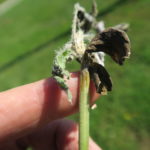
A recent observation of gummy stem blight on a watermelon transplant has reminded me to remind growers to inspect seedlings. Whether one is growing transplants or receiving transplants for delivery, seedlings should be inspected for possible disease problems. If one is uncertain of the cause of the symptoms, an official diagnosis can be obtained by…Read more about Watermelon Transplant Diseases[Read More]