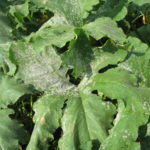
Powdery mildew is a common disease of cantaloupe and pumpkin in Indiana. Occasionally, I observe this disease on watermelon as well. Recently, I have noticed more powdery mildew than usual on watermelon. If left uncontrolled, this disease can cause loss of foliage, loss of yield and lower quality fruit. This article will discuss the biology…Read more about Powdery Mildew of Cucurbits[Read More]
Cucurbits

One of the most common diseases of pumpkin in Indiana is powdery mildew. Growers are naturally anxious to observe whether the fungicide they have been applying for this disease has been effective. Therefore, many pumpkin growers scout their fields for disease. Although powdery mildew is relatively easy to recognize, it is possible to become confused. …Read more about Powdery Mildew Symptoms vs Variegated Leaves[Read More]
Read more about Powdery Mildew Symptoms vs Variegated LeavesAfter harvest, storing vegetables in optimal conditions is important to ensure the whole season’s hard work has paid off. This article discusses the optimum storage conditions for tomato, pepper, cucumber, watermelon, cantaloupe and sweet corn. Tomato Ideal storage conditions for tomatoes depend on the maturity stage of picking. If tomatoes are picked at mature green,…Read more about Optimal Storage Conditions for Vegetables[Read More]
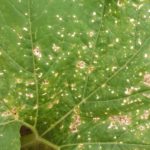
I have observed this disease in scattered commercial pumpkin and squash fields across Indiana. Bacterial leaf spot of pumpkin is perhaps the most serious disease of pumpkin in Indiana today. Symptoms: Bacterial spot causes ⅛-¼ inch angular leaf lesions that are white to light brown in color (Figure 1). These leaf lesions may be accompanied…Read more about Bacterial Spot of Pumpkin[Read More]
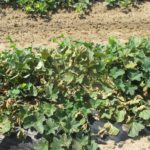
Manganese toxicity is a common problem for cantaloupes growing in sandy soils across southwestern Indiana. Because symptom of manganese toxicity can easily be confused with foliar diseases, growers may misdiagnose the problem and waste fungicides by spraying for nonexistent diseases. As we now know that manganese toxicity is a nutrient related disorder caused by low…Read more about Manganese Toxicity on Cantaloupes[Read More]
I have observed very few foliar diseases of cucurbits this season. However, I have had several worried phone calls about these diseases, so here is an update. Alternaria leaf blight-this disease is caused by a fungus that survives in crop residue. It usually is not an important disease. However, Alternaria can cause brown lesions with…Read more about Foliar Disease of Cucurbit Update[Read More]

In southern Indiana, we are between generations of striped cucumber beetles. That doesn’t mean there are none out there, but numbers are lower than they were and lower than they will be. The second generation should be coming out soon. Northern areas are a little behind. The biggest concern we have with the first generation…Read more about Striped Cucumber Beetles[Read More]
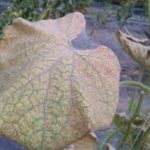
It is that time of year again, when the two-spotted spider mites (Tetranychus urticae; TSSM, Figure 1), and other mite species, show up in full force and wreak havoc on fruit and vegetables. These pests are very inconspicuous and often go unnoticed until the resulting damage appears. For TSSM this includes the webbing produced on…Read more about Two-Spotted Spider Mite Control[Read More]
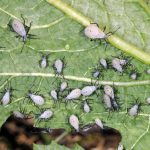
Squash bug is the most consistent insect pest of squash and pumpkins and is the most difficult to control (Figure 1 and 2). The key to management is early detection and control of the nymphs. The adults are extremely difficult to kill. Foliar insecticides should be applied to control the nymphs when you have more…Read more about Squash Bugs[Read More]
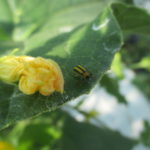
Populations of the overwintering generation of striped cucumber beetles are just about at their peak levels right now (Figure 1.). For muskmelons and cucumbers, this generation is the one that we worry the most about in terms of transmitting the pathogen that causes bacterial wilt. As a result, our spray threshold is relatively low, 1…Read more about Striped Cucumber Beetles[Read More]