At Southwest Purdue Agriculture Center in Vincennes, IN. We are conducting trials to evaluate annual plasticulture strawberry production systems. Here are the updates of strawberries from different production systems. In a high tunnel, harvest of fall-planted strawberries started in early April. Cultivars Sensation, Radiance, Ruby June were early cultivars; followed by Beauty, Fronteras. So far,…Read more about Annual Plasticulture Strawberry Update at Southwest Purdue Agriculture Center[Read More]
Crop Culture
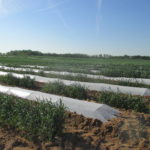
Two types of injury on young warm-season vegetable plants are caused by low temperatures: frost/freezing injury and chilling injury. Frost/freezing injury occurs when temperatures drop below 32°F. Ice formation in plant tissue cuts cell membranes. When the tissue thaws, the damage results in fluids leaking from the cell, causing water soaked damage. Frost/freezing injury is…Read more about Protect Early Planted Warm-Season Vegetables from Low Temperatures[Read More]
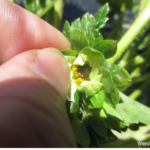
Spring weather is unpredictable. One of the major risks associated with strawberry production is cold damage in the spring. Open strawberry flowers can not tolerate temperatures lower than 30°F, popcorn stage flowers and tight buds may tolerant temperatures low to 26 and 22°F, respectively. If strawberries are in the early blooming stage, the damage might…Read more about Strawberry Cold Protection Made a Difference[Read More]
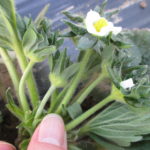
Warm temperatures this week greatly encouraged strawberry growth and development. Some of the early cultivars may have entered the open blossom stage especially if they are grown with the annual plasticulture system in southern Indiana. Open flowers cannot tolerate temperatures lower than 30°F, while popcorn stage flowers (Figure 1) and tight buds may tolerant temperatures…Read more about Strawberry Growers Should be Prepared for Cold Protection[Read More]
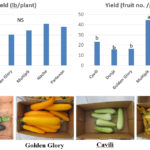
Warm-season vegetables like tomato, cucumber, pepper etc. often receive premium prices if they were sold at farmers’ markets earlier in the season. The same happens on summer squash, with the different fruit shape and color, summer squash provides a great diversity to the market. High tunnels that are planted with warm-season vegetables are often closed…Read more about Summer Squash Cultivar Selection for High Tunnel Production[Read More]
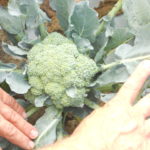
Cool nights have finally arrived after the first week of October. Before, we had quite a few days when temperatures were above 90°F. The unusual high temperature has caused problems on early-planted broccoli. Broccoli is a heat-sensitive crop. The critical period for heat sensitivity is when plants shift growing tips from vegetative growth to flower…Read more about Broccoli under Heat Stress[Read More]
The 2019 production season started with above-normal rains. The wet conditions affected agriculture production, including watermelon and cantaloupe. In this article, we will review some of the watermelon and cantaloupe problems that are often associated with wet conditions. Manganese toxicity– This nutrient disorder occurs more often on cantaloupe that is grown in soils with pH…Read more about Results of Wet Condition on Watermelon and Cantaloupe[Read More]

The wet spring has likely delayed some planting of pumpkins. What does delayed planting mean for yield? Data and observations from Purdue Ag Centers offer some perspective to supplement other experience. Figure 1 shows how pumpkin yield was affected by planting date for 6 trials. Each line represents a different trial. The Y-axis shows relative…Read more about Considerations with Delayed Pumpkin Planting[Read More]

Finally the time has come to plant warm season crops. Zucchini is a popular summer squash grown throughout Indiana and the United States. It always delivers a bounty of fruit. Yes, technically zucchini is a fruit (botanically classified as a modified berry) but as per the USDA it is listed under the ‘Vegetables and Vegetable…Read more about Growing a Bountiful Zucchini Crop[Read More]
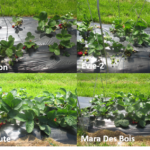
With the support of the Purdue Extension AgSeed Program, we are currently evaluating different production systems for growing strawberries in an open-field with plastic cultural systems for our area at Southwest Purdue Agricultural Center in Vincennes, IN. A day-neutral strawberry cultivar evaluation trial was established in the Spring of 2019. The evaluated cultivars include Portola,…Read more about Spring Planted Day-neutral Strawberry Update[Read More]