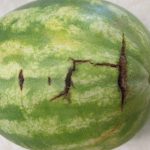
Cross stitch of watermelons is a physiological disorder (not caused by an infectious disease) first reported in 1990s on watermelon fruit. It received the name because the symptom looks like cross stitch. One or more rows of oval-shaped lesions lie along with the longitudinal axis of the fruit. These lesions are normally more close to…Read more about Cross Stitch of Watermelons[Read More]
Crop Culture
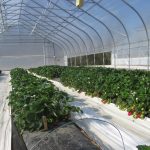
We are familiar with strawberries grown as a perennial crop in Indiana. Bare root strawberry plants are set in the spring. Fruit is first harvested in the second year and the planting is renovated annually. Using this system, strawberry seasons last for three to four weeks from middle May through June. The traditional system has been…Read more about Evaluation of Strawberry Varieties for High Tunnel Production[Read More]
Last week, the highest temperature reached 110°F for a few successive days inside of our high tunnels. As a result, we observed some blossom drop on tomatoes. More information on high temperature effects on tomato fruit set can be found here. In addition to blossom drop, high temperature and high light intensity contribute to sunscald injury,…Read more about Whether to Put Shade Cloth on High Tunnel Tomatoes[Read More]
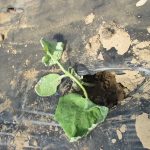
Last week, we received calls from several watermelon growers who reported that their newly planted watermelon seedlings had died (Figure 1). After closely inspecting the affected plants, we did not find any pathogens. This reminded us of what happened to our cucumbers back in early April in our high tunnel. We will review the cucumber…Read more about Establishment Failure of Watermelon and Cucumber Transplants Because of Low Soil Temperatures[Read More]
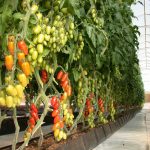
Planting density plays an important role in the optimization of labor efficiency and productivity of your high tunnel. For the purpose of this article I will focus on tomato which is commonly grown as a high value crop on small farming operations. Usually growers select varieties according to customer (market) preference and then try to…Read more about Link between Plant Density, Yield and Revenue from a High Tunnel[Read More]
Every year since 1980, we have conducted watermelon and cantaloupe variety trials at Southwest Purdue Agricultural Center. In 2016, our variety trials include 44 standard seedless watermelons, 12 cantaloupes, 4 mini-sized seedless watermelons, and 5 seeded watermelon varieties. Seeds have already been planted in the greenhouses and our target date for transplanting in the field…Read more about 2016 Watermelon and Cantaloupe Variety Trials at Southwest Purdue Agricultural Center[Read More]
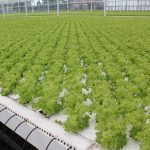
Travelling through Indiana last summer, I realized that many growers plant their crops in soil inside their high tunnels or greenhouses. Soilless production offers different benefits and challenges. This is the first article in a series focusing on soilless crop production in high tunnels and greenhouses. Today we are discussing Hydroponics. What is Hydroponics? The…Read more about Opportunities in Hydroponics[Read More]
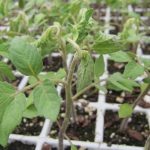
Tomatoes grown in controlled environment are exposed to conditions that are different from their original habitats. As a result, varieties that are not specifically bred for greenhouse production may respond to the controlled environment with abnormal symptoms. One group of the symptoms is called edema. Bumps, galls or blisters develop on tomato leaves, petioles or…Read more about Edema on Tomato Rootstocks[Read More]
Crop production, decomposition of organic matter, using ammonium-producing nitrogen fertilizers, and rainfall all lower soil pH. To maintain soil pH in the optimal range (6.5 to 6.8) for vegetable production, periodic application of lime is needed. The primary form of agricultural lime is calcium carbonate (CaCO3). It is the carbonate (CO3^2-) part that brings up…Read more about Liming[Read More]
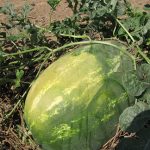
Loss of foliage due to poor growing conditions or disease can cause fruit to be exposed to the sun. Hot temperatures and direct sunlight can lead to areas of the fruit that appear bleached or sunburned. Sunburned fruit may not be marketable. To reduce the probability sunburned fruit, every effort should be made to maintain foliage…Read more about Sunburn on Vegetables[Read More]