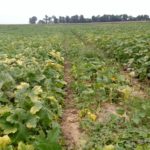
In the last several days I have received complaints of pumpkin plants with yellow leaves. Growers want to know if the yellow is a symptom of disease and what can be done about it. Yellow lesions on leaves may be symptoms of disease. There can be many reasons why pumpkin plants have yellow leaves. Usually,…Read more about Yellow Leaves on Pumpkin[Read More]
Cucurbits
Downy mildew has been observed in Knox County on cucumber. In addition, downy mildew on cucumber has been reported in central Michigan on cucumber and central and northern Ohio on cucumber and cantaloupe. The downy mildew race type found in Knox county that goes to cucumber and cantaloupe may also go to other cucurbits such…Read more about Cucumber Downy Mildew Found in Indiana[Read More]
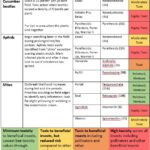
Unfortunately, pests don’t know when to take the day off. Even though we have bees in the field and watermelons reaching peak bloom, we still need to watch out for pest infestation and disease outbreaks. First and foremost, scouting fields to monitor pests will ensure that infestations never reach high enough populations to threaten yield….Read more about Spray Less, Pay Less, and Get Better Control of Your Arthropod Pests[Read More]
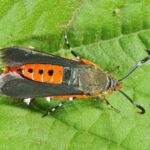
For some, we may often forget about the pesky squash vine borer until it’s too late. This pest of cucurbit crops tends to be sporadic in our region; you are either battling it every year or it hardly makes an appearance. And, unfortunately, our urban farmers tend to get hammered. While it is not so…Read more about Time to Scout for Squash Vine Borer (SVB)[Read More]
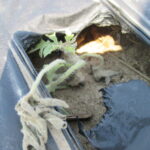
In early May, we had an extended cold period with daily average air temperatures in the 50s°F. Min temperatures are in the 40s°F, some nights even upper 30s°F. In most areas in southern Indiana, it is fortunate we did not encounter a frost with temperature dropped below 32°F, but the low temperature for the extended…Read more about Why do Watermelon and Melon Plants Wilt?[Read More]
Pumpkin planting is right around the corner. The recent Vegetable Beet Podcast produced by Great Lakes Vegetable Producers Network featured Brad Bergefurd from The Ohio State University and Nathan Johanning from University of Illinois talking about Pre-season Pumpkin Tips. They shared many of their insights in planting spacing, fertility management, weed control, no-till etc. A…Read more about Pumpkin Resources[Read More]
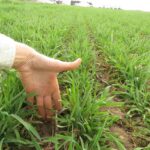
In a recent Hoosier Ag Today/CCSI Soil Health Podcast, Stephen Meyers of Purdue Horticulture and Dan Perkins of Perkins Good Earth Farm covered spring management of cover crops on vegetable farms. They discussed a variety of methods for terminating: flail mowing and tarping, roller-crimping, tillage, and killing with herbicide. They pointed out that decisions about…Read more about Cover Crops in May: Soil Health Podcast on Spring Management and Observations of Winter Rye at Pinney Purdue[Read More]
MELCAST is a weather-based disease-forecasting program that helps growers schedule foliar fungicides applications for watermelon and cantaloupe. MELCAST stands for MELon disease for CASTer. This program, designed by Dr. Rick Latin, Professor of Plant Pathology at Purdue University, keeps track of weather conditions so that cantaloupe and watermelon growers can apply foliar fungicides to their…Read more about MELCAST 2021[Read More]
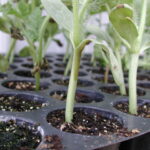
Many cantaloupe and watermelon growers are either growing transplants in a greenhouse or are expecting delivery of transplants in the next few weeks. Either way, growers should inspect transplants for disease before planting in the field. Below I will describe several common transplant diseases of cantaloupe and watermelon as well as management options. Gummy stem…Read more about Cantaloupe and Watermelon Transplant Diseases[Read More]

The average American eats almost 9 pounds of cantaloupe and 2 pounds of honeydew each year (Agricultural Marketing Resource Center, 2018). An increased melon consumption is mainly explained by consumer awareness of melon health benefits, year-round availability, creative marketing strategies, and improved cultivars. To address these economic opportunities, retailers, growers, and other industry stakeholders should…Read more about The Three Types of Melon Consumers[Read More]